Study by Durst on water-based polymeric inkjet inks reveals that the consumables characterised by two important components: water as the main carrier and polymer as the glue to make the ink stick to various substrates. These are mainly paper-based materials and plastics, but include glass, metal and other materials. The motivation to use water-based inkjet inks is relatively simple: there is no extraction needed, there are no monomer problems and water-based inks are generally seen as a ‘green’ solution. However, while water-based inks are prevalent on the desktop, penetration into industrial applications has been slow: water-based inks had widely been seen to require porous or specially treated substrates and to suffer from problems in adhesion to non-porous substrates.
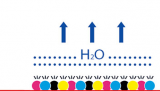
The process of how the inks work is as follows: 1. Ink droplets are deposited onto the substrate. Due to polymers and formulation chemistry, the liquid droplets are immediately fixed to the surface of the substrate, leading to round spots. Adjacent spots should not mix. 2. Drying, meaning getting rid of all of the liquids (water and humectants). Water inhibits quite a significant evaporation enthalpy, requiring drying systems to be well-focused and sophisticated; non-uniform drying does negatively influence print quality (banding). 3. Film forming: the polymers inside the ink film combine which each other more closely and start interacting. The physico-chemical mechanisms behind it are not fully understood on a scientific basis and do vary, dependent on the ink system.